In April, a month or so after arriving in Dubai, I wanted to find some kind of outdoors trip to go on over the long Eid weekend. I thought that I might find something suitable on Meetup, and there I came across the Dubai Adventure Wanderlust group. I phoned the number in the details and spoke to Zeus, asking firstly what their trip involved, and secondly if it wasn’t too late to join in as they were leaving the next day. It was to be a road trip and dune bashing trip to Abu Dhabi, which all sounded very interesting, and so I signed up as a passenger in the car of Zeus’ co-organiser, Naveen.
With no car of my own, no camping equipment, or any useful experience at all, I had managed to find a very welcoming group of people who were more than happy to lend me kit and take me as a passenger on their trip.
Naveen picked me up at SOBHA in a heavily laden FJ the next morning, and off we went to the rendezvous point about 45 minutes out of the city on the way to Liwa. What a lovely guy; he was about 50, retired after a career during which he worked in all sorts of countries in various continents, and now enjoyed a life beetling in and around the UAE and, in the summer, India. He was an ‘uncle’ type – full of advice and encouragement about life, work and travel with a fun, prankish sense of humour. He had a clear love of nature and we talked about old Indian cricketers…
About 10 or so cars convened at the rendezvous point, after which we then convoyed to the first stop on our journey to Liwa. Thus far in Dubai, my exploration of new places had been limited the parts of the city only accessible by metro. The Eid trip ended up being a vast expansion of that horizon, and when I returned to the city and told friends and colleagues of what I’d done over the weekend, I realised how unusual and special it was to’ve ventured so far out into the sticks and experience the lives of those who live and farm out there. It was an entirely different side of the UAE, which I’ve tried to continue and explore since.
We stopped at the salt lakes in the Al Wathba desert. The convoy parked up, having driven for a while off road on a fine sandy track, along the edge of a 3 / 4-metre deep trench, that stretched way off ahead of us in a straight line that had been dug into the sand for a reason I couldn’t quite establish. The ‘lake’ was shallow and occupied the trench bed only in patches, allowing us to climb down and get close to the water. Around the perimeter was a crust of salt, and just beneath the surface were salty stalagmites rising up out of the murk. The taste was even saltier than the appearance; the smallest fingertip droplet had an intense burn that lingered even beyond the relief offered by some sour jelly ghekos that I quickly conjured from Naveen’s glovebox.
After a while, the team got back into their cars ready to head off to the next stop, which was to be fossil dunes. But a small-scale disaster had struck the drive belt of one of our cars, and so Naveen and I had to tow a couple of our number back to the road to await rescue. It was amusing to hear Naveen speak urdu to the mechanic, as long trains of dialect were intermittently punctuated by technical english words that clearly had no translation… he explained urdu was quite a basic language that was easy to learn.
We caught up with the rest of the team as they were leaving fossil dunes.
The next stop was a camel farm, which was somewhere vaguely near the ‘Milkyway Spot’ in Al Quaa (a recording of a walk on Strava is all that I have to know where in the world we were that day) . The only camels I had seen to date (other than those seen from the car that day) were two sad-looking beasts that were kept in a nasty little corner of JBR beach, which were marched up and down along the watersedge for the benefit of tourists; they can’t’ve particularly happy creatures. The camels we encountered in the desert, however, seemed lively, social, inquisitive of us, clean, healthy and altogether perky. We arrived on the farm and were met by the farmer himself, dressed in the pristine white thabe. He unrolled an enormous rug under a canopy roof on the side of his house and served us all deliciously sweet karak chai – a drink I then became very fond of – which we drank whilst sitting and chatting on the rug. The farmer was the first of Naveen’s many contacts we were to come across and enjoy the hospitality of over the weekend.
It was this that formed the thread through the trip; the places and people we were to visit were all contacts of Naveen’s that he’d befriended through his own travels over the years. It transpired that there are a lot of hospitable and welcoming people out in the desert; the key is to know their language in order to build friendly personal relations. After that, many of them are more than happy to accommodate travelers camping on their farms, in return for some food, drink or cash that they can send to their families in their home countries.
Behind the house were the camels. They occupied two sections beneath a tin roof; one was a pair of enclosures for the younger camels, next to which was an open area for the mothers. Some of the mums seemed very happy to see us and bowed their heads down for chin and neck scratches. Happy grunts came from all directions. The younger camels seemed very nervous, preferring to huddle together at the back of their enclosure as we got nearer. Naveen advised us that the camels were bred for racing.
The farmer wandered over with a large silver bowl and milked one of the camels. The bowl was offered around and we drank the milk, which was quite salty, warm from their body temperature, quite thick and frothy. When we returned to the rug under the canopy next the house, we sat and drank karak with the camel’s milk.
Our next stop, which was to be for the night, was close by. Before leaving, the farmer lent us the rug so we’d have somewhere to sit as a group that evening. Naveen rolled it up and strapped it the roof rack of the FJ. It seems that everyone out in those parts has a good selection of rugs – we’re in Arabia after all.
We then travelled to our spot for the night. It was a date palm farm inhabited by an interesting character from Bangladesh. The farms are all the property of the local Sheikh who, as I understood it from Naveen, finances their planting and construction and organises their management. The topography of the farm was roughly in the shape of a bowl, and in the centre were the date palms. The bowl was deep enough such that the fronds of the palms were below the perimeter rim. Sitting on the edge, I could look across and between the palms and see the Bengali farmer wandering around attending the hose pipes that wrapped around the palm trunks. There was a constant supply of water to all the trees, 24/7, which I wouldn’t’ve expected to see out in the Arabian desert, but as it happens the water table is only a few metres down. As I came to realise from the various farms we visited on the trip, there are always pumps and water tanks to facilitate an everlasting supply of (fairly salty) water. Hence we came across these seemingly impossible palm oases in the middle of the desert.
Next to the leafy bowl was a mosque, which is unusual to find on a private, isolated farm. Naveen explained that the farmer was a Mullah, i.e. the voice that projects out the call to prayer from the megaphones of mosque towers. Religious activity such as this, Naveen suggested, was the only thing that some of these lonely farmers have for keeping their minds active and focused during their isolated lives away from their families. This might seem sad, but I considered the farmer’s life to be much better than the labourer’s in the city, which appears to be a far more demanding and dangerous way of returning cash to families back home.
We found a few spots to park and set up the tents on the edge of the farm, tucked into a border of trees and bushes. We had the rest of the afternoon and evening to relax and wander around. Then appeared the Mullah. It was a strange sight; orthodox muslim dress, including beard and prayer cap, whilst straddling a quadbike full of tools. “Fine?” he asked me, after Naveen had introduced me as an Englishman. We managed to have a bit of a conversation, during which I learnt he had a brother who was a shopkeeper in London (probably Bethnal Green). When I asked him if he’d visited London, he told me that didn’t like England as there were too many Bengalis living there… I found it difficult to navigate his character, which seemed to lie somewhere between friendliness and hostility.
Naveen then transferred some food from his car to the quadbike. The two of them disappeared to the Mullah’s kitchen to prepare the evening meal. I napped and read some of the book I’d brought along – the tale of Phileas Fogg and his journey around the world in 80 days. I also got to know some of the team a bit better. Z was born in Japan, and had spent much of her life living in different parts of the world scuba diving. T was Moldovan and had been living in Dubai for 13 years, and also scuba’d in her spare time. Alex and his wife had just moved from Russia, where Alex had felt concerned that he might’ve been drafted into the military to fight in Ukraine had he stayed any longer. There were other families, one from Singapore, one from India, and a few other that I didn’t get the chance to talk to. I kept in touch with Tatiana and Zeus after the trip as scuba was something I wanted to try – and this did subsequently happen.
The food arrived in vast pots on the Bengali-straddled quadbike. It was a curry with roti, salads and some juice. The Mullah joined us and ate in the traditional way, sat on the floor using his right hand to pinch the roti and pick up the food.
Before going to bed, Zeus suggested going for walk out of the farm into the desert, with the chance of seeing some of the meteor shower due that weekend. A group of us headed out, climbing through a gap in the wire fence. The sand was incredibly soft, so we took our shoes off and walked into the night barefoot. We climbed a dune or two before settling on a ridge. We laid down, chatted for a while, and then simply fell silent looking up to the starry canopy above us. It was so relaxing that we were in danger of falling asleep right there on the ridge, so we decided to head back and hit the hay.
I thought it would be nice to try and see each sunset and sunrise of the weekend. I set an alarm for the AM, to get up and follow the same route we’d just taken. When it came to the morning, however, there was no need for the alarm at all, as out of the absolute stillness came, at an extraordinarily loud volume, the Mullah’s call to prayer, which was a haunting but energising sound to suddenly wake up to.
There had been no wind overnight, so our tracks from the previous walk were still perfectly formed in the sand down to each individual toeprint. It was quickly becoming light as I started retracing the prints and there were reds and oranges reflecting from some of the clouds – the sun falls and rises very quickly in this part of the world. As I came over a dune, there then appeared another desert delight in the form of two gazelles, which were hopping around and nibbling on some of the tufts of desert grass, though they quickly disappeared once they’d seen me. This was my first introduction into desert wildlife; more encounters with all sorts of animals – furry, scaly and creepy-crawly – would follow in the next few days. From the horizon rose the orange ball, and with it came the heat. A pleasant aspect of the weather that far in land was the absence of the humidity which pervades the city of Dubai so intensely, so it was more than bearable over the weekend.
I got back to camp and went straight back to sleep, which became the weekend routine: wake up, sunrise, return, nap. Meanwhile, Zeus and Naveen were diligently laying out breakfast. I woke up, again (though this time not to the sound of the Qur’an blasting through the palms), joined in with the team and had breakfast, then we all assisted in the pack up so we could continue on the way to Liwa. The Mullah appeared on his quadbike and we said our thankyous and goodbyes, and then headed off.
Our next leg was a couple of hours on the roads towards Liwa, ultimately heading to Mezairaa – a town on the edge of ‘the Crescent’. Naveen and I were chatting about all sorts of things on this trip. He introduced me to Wilfred Thesiger, a Twentieth Century English travel writer, and advised that I should try and find a copy of his book ‘Arabian Sands’. It describes Thesiger’s journeys across the Empty Quarter with the Bedu in the 1940s, when the traditional Bedouin lifestyle and tribes still existed. I did subsequently find this book; I listened to it as an audiobook on my commutes to work on the metro, and later found a couple of editions of it in Alserkal Avenue. Naveen was also describing the different structures of the dunes, contrasting the flatter, smaller dunes which we’d been passing through with the much larger dunes which are encountered in the Empty Quarter. Looking back at the spots we’d stopped at on Google Maps, these immense dunes are clearly visible and are very distinct from the rest of the desert in the UAE. We also passed through areas of salt flats between dunes, where we saw a few mini sand typhoons forming as the winds were funelled through.
A brief stop in Mezairaa allowed us to restock on food for the next couple of days and eat in one of the local restaurants. This was the first time I’d seen a more traditional restaurant where there were a number of low cubicles adjacent to the chairs and tables, in which patrons could eat as the Mullah had done, picking the food up with their hands whilst sat on the floor. It was also an opportunity to have some sweet Turkish coffee for all of one dirham.
Mezairaa town was on the northern edge of the Empty Quarter. We continued in a Westerly arc around its periphery and as we went, the dunes were rising to a much greater height and had much steeper edifices. The sand was also a deeper red towards the Empty Quarter; the desert environment seemed to be getting more hostile and inhospitable, which served only to add to the thrill of travel and exploration. I should say at this point that I had no preconception of this trip, I had no idea of what to expect, I knew nothing of anyone I’d be sharing it with or anything of the places we were visiting. But with such experienced guides in Naveen and Zeus, I was utterly comfortable in my total ignorance and thus could explore these extreme environments with an open mind. It was a wonderful lesson in spontaneous travel and building instant friendships through new experiences.
Some of the group had gone home after the first night, though a couple of new cars joined us in Mezairaa for the next stage. We were down to about five or six cars. We skirted around the arc on the top side of Empty Quarter in what’s known as the ‘Liwa Oasis’, before then turning away from the Cresent on the Um Al Hisn Road, heading north-west. The roads in this part of the emirate are extremely long and straight, with very few features for long stretches of time. They’re soporific as a result, so we focused our minds with the Eagles and some other tunes from Naveen’s playlist. Naveen dealt with the intense brightness of the desert by wearing ski goggles he had dangling from the back of his headrest, which was an amusing sight.
On the Um Al Hisn Road, we eventually came to a gate that opened onto a farm track running perpendicular into the dunes. We went through the gate, stopped to deflate tyres, and then began the sandy route deep into the desert. We followed the track over the undulating dunes, the track being all of tyre grooves in the soft sand, reinforced with occasional smattering of loose gravel. Naveen spiced the route up with the occasional sporadic right turn into the desert proper, taking us on meandering routes over the dunes and even down one of the steep sandy cliffs. The capabilities of the FJ were amazing; I thought we would surely capsize at some of the angles at which we straddle the dunes, but of course, Naveen was so experienced and handled the car with balance and judgement as if it were an extension of his own person. As I’d never off-roaded before (other than across the odd cricket pitch in Dorset), this was a real adrenaline rush… and ultimately led to my own investment into an FJ!
We continued further on our duneful drive, undulating over the great ridges that offered expansive views in all directions of these immense natural structures. As I’d seen the gazelles earlier that day, I was keenly scanning for any signs of life. Deliciously, I spotted something small down to our right running along the side of a dune which, once Naveen had also spotted it, we confirmed to be a desert fox.
Eventually, we crested a dune and to our left was a palm oasis. We veered left and headed on a downward gradient towards the palms; this was to be our home for the next two nights. The oases are all generally positioned at the bases of dune-encircled bowls, presumably as these spots are closest to the water table and are relatively sheltered from the desert winds and sandstorms. The farm appeared as a tight, triangular grid of palms set against the base of a steep dune rising behind. It was spectacular, considering how deep into the desert we were, to find this lush little corner of life, and to be heading directly towards it! No commercial enterprise could take us to a places like this; it was Naveen’s serendipitous discoveries through his own travels, together with his vast resources of urdu dialects, that had made these places available to we whom he and Zeus had organised out of their own love for introducing new people to these experiences. I am so grateful for it.
–ooOOoo–
The farm was farmed by a farmer called Rachi Gul. He had a co-farmer, too, but he was away for the Eid holiday. We pulled up adjacent to the little concrete house and were greeted by Rachi, also dressed in the white thobe. What a greeting we had; Rachi was holding a full tray of cold juices that he offered round, and after we had each taken a cup, he returned to his house to retrieve a full dish of freshly cut watermelon and figs. The figs were a particular delight. The drink and food was the perfect cocktail of freshness, sweetness and hydration that we could’ve had after the long desert drive, and was a delicious first impression of this sheltered, green oasis in this nowhere-in-particular corner of the Arabian Desert. Chickens clucked to our left.
Next, we had a tour of the farm to get familiar with our surroundings and the activities of our host. Behind the house was Rachi’s vegetable garden, where he grew various things such as onions, tomatoes and the famous figs. Rachi shuffled sideways between the tall stalks of the fig plants to retrieve even more of the fruits, which he tossed to us to eat. Walking on, we saw the farm’s water reservoir, fed by a pump powered by an array of solar panels, and were advised that we could use it as a paddling pool if we fancied taking a dip over the next couple of days. Rachi’s ‘summer bedroom’ was next – this was an interesting structure adjacent to the main house, serving as a naturally-cooled space for the intense heat of the summer months. The construction was a scaffold pole-framed cuboid. The walls were formed with an exterior skin of palm fronds and an interior skin of hemp. A hosepipe ran around the ceiling perimeter with pinprick holes pierced at close spacings, with a small cut of hemp cloth draped over each hole. The effect of the mechanism was to continuously, slowly soak the interior hemp skin with water. The saturated hemp cooled any desert winds blowing through, and thus Rachi had established a basic air conditioning system that kept the room comfortable all year round. We then headed down to the palms, where most of the team set up camp. Naveen and I decided to commandeer the summer room. It’s good to have friends in high places.
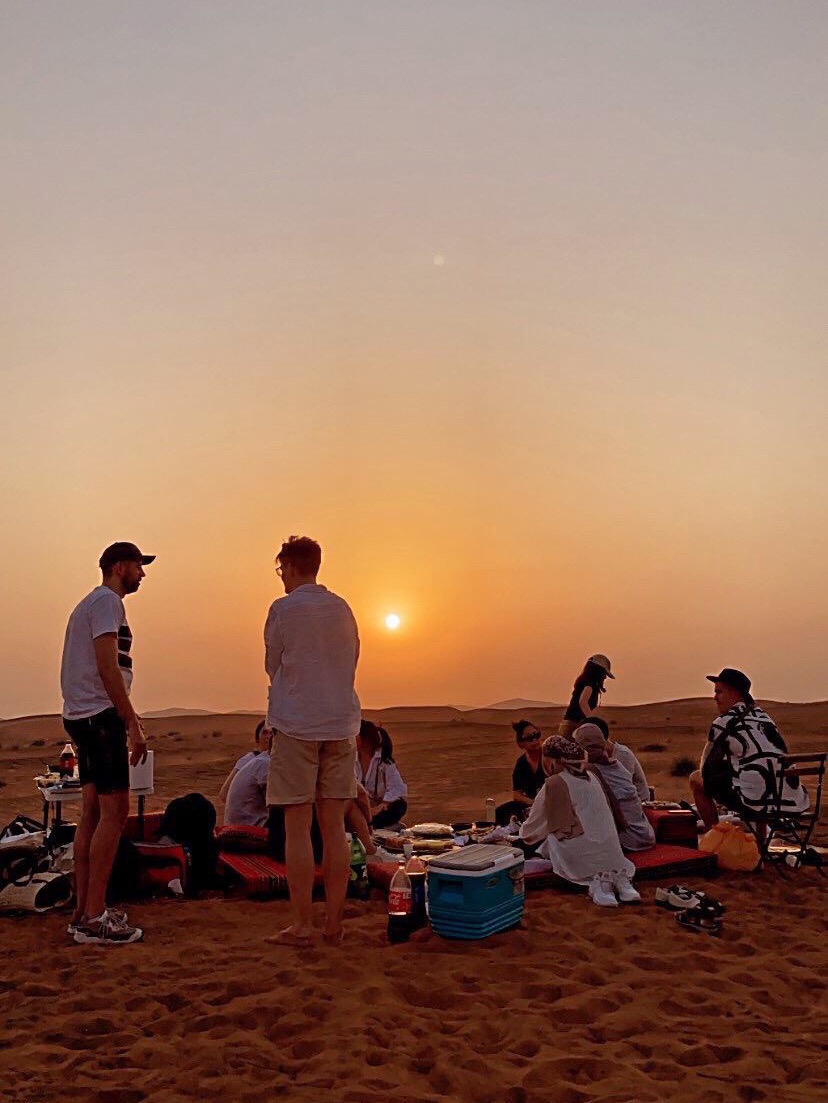
The only planned event I had for the evening was to see the sunset. With no watch, it was the great celestial clock falling towards the peaks of the dunes that signified it was time to head upwards out of the farm and seek out a good vantage point. Sitting on a ridge, I was immersed into the orange and pink stillness of another desert sunset. An occasional breeze blew sand into me, so I tucked my camera underneath my shirt to protect the lens and stood up to get my head above the current of sand grains, which blew over the edge of the ridge and cascaded over the steeper side down towards the farm. Tatiana had also come out of the farm but had walked a bit further out into the desert, and I could see her between my spot on the dune and where the sun was falling towards the horizon. She was meditating as she walked rightwards across the scene. Afterwards, she explained that she was focusing on the texture of sand on her feet as she took slow, long strides, with her eyes closed, breathing deeply. The light disappeared quickly, so I got up and headed back down to the house for dinner, but instead of retracing my steps along a gentle descent around the bowl, I decided to go directly down the steep face of the high dune. The sand was incredibly soft and my feet plunged deep into it. A good few metres elapsed between each stride as a result of the steep gradient and my downward drift with each step. The sand was almost liquid-like around my feet, and the displaced grains slid and poured around my ankles and shins as I skipped down to the base of the dune.
Rachi Gul’s preparation of dinner was a thing to behold. The kitchen – one of the two rooms that constituted his house – was equipped with a simple gas stove and a few cupdboards and drawers of basic supplies. Next to the kitchen was an area in which he prepared his roti. First, the roti mix was rolled out on a worktop into a wide circle. Next, he lit a fire inside an oil drum laying sideways on the ground with palm fronds, twigs an bark as fuel. Once the drum was hot enough, he draped the roti dough over its top, allowing only a short time before picking it up from the drum with a stick and flipping it over. This was repeated several times, and after cooking it through evenly, he lifted it off the drum and folded it into a lidded clay pot, to accompany the curry Naveen was cooking in the kitchen next door. We sat in the yard outside the house on camping chairs, and ate as Rachi cooked and supplied more and more roti. Tatiana spoke about her diving trips in Egypt and the Maldives, and showed me her photos of whale sharks, manta rays and shipwrecks.
As we were clearing up, along the ground came scuttling the largest spider I’d ever seen. It was a camel spider, which Naveen explained was harmless to us despite its large size. They’re burrowing spiders, rather than web spiders, and have two particularly long front legs that they use to trap desert mice after pouncing out of their holes. It scuttled to the house, climbed a wall, and disappeared through some reeds. Maybe it was after some roti.
Later, Zeus suggested that we ought to try and catch more of the meteor shower. This time, instead of walking out to the dunes, Tatiana, Zeus and I climbed up to Rachi’s water reservoir and hopped in to the water, which was as warm as a bath having heated up in the sun all day. We floated on the surface for a long time, watching the stars and meteors. As my ears were just below surface, all I could hear was an occasional submerged slosh as Tatiana adjusted her angle of floating. After drying off, I walked back to the summer house and went to bed, thankfully avoiding any further encounters with camel spiders.
The morning was another early start to go for a desert sunrise walk. I didn’t see any animals this this time, but did see numerous tracks of creatures that had been roaming around overnight. Snake tracks and mouse footprints were the most common. In one instance the two appeared together, showing what appeared to be a chase, until the mouseprints came to an abrupt stop, whilst the snake tracks continued onwards. Poor mouse. I did a loop of the farm, stopping for a while to watch the sunrise, and noticed two tracks of an animal I surmised to be the fox we’d seen the day before heading in and out of the farm. Perhaps it had been on a night raid of Rachi’s vegetable garden, or had been after a smaller animal sheltering in the oasis.
I got back and went straight to sleep on the floor of the summer house. There were three sounds which I then woke to: Rachi Gul pottering about, cleaning and tidying his kitchen and yard; his chickens, quietly murmuring in a low pitch a little further away; and the gentle trickling of water down the walls around me from the pierced hosepipe above. I lay still for a while listening to these three sounds, aware of their position in the foreground, mid ground and background of my field of hearing, changing my focus between the three. I then became aware of a sudden feeling of absolute calmness and fulfilment where I was, listening to these pleasant, quiet sounds, which recalled to my mind a passage about peak experiences in Colin Wilson’s The Outsider. I wondered if this was the sensation he had described. Reflecting on that experience now, it seemed like the combination of such relaxation over the previous couple of days and the focusing on these three sounds with no distractions at all had resulted in some kind of fulfilled, calm happiness, but more than that, a conscious and almost intense awareness that I was so relaxed and clam. Anyway, all of that was shattered as one of the team’s car alarms then went off, so I got up and helped Naveen and Zeus set up breakfast.
That morning, most of the team left to return to Dubai. We were reduced to three or four cars. Once we were ready, we traveled a little further along the farm track off of which we’d got to Rachi’s farm, to a second farmed inhabited by a couple of happy little blokes from Balochistan, who Naveen also knew.
Their farm was very different. I got the impression that the Baloch farmers were perhaps contractors before they’d come to Dubai, as their farm and buildings seemed to be much more advanced and better-maintained than Rachi’s. Their house was pristine white, rendered on the outside, and had a separate block in which the farmers had built an immaculate washroom (with a sitter rather than a squatter) and an outdoor tiled footwash for ablutions and washing away the sand and dirt from work on the farm. Their oasis was also better established; it was thicker, more varied in its species, and was fun to pick our way through on our hunt for figs. The third, and most impressive, feature of this particular farm was the garden that the two men had constructed. It was an impossibly perfect lawn of lush green grass, moist from the constant spray of the hoses, and bordered with flowers and picket fences as if it were a cottage garden in England. At the end of the garden was a patio with a tensile canopy roof over a sofa, and its backdrop was another immense dune. Tatiana commented that it looked suitable to be a wedding venue. We laid on the grass for a while which, in this part of the world, I consider to be a luxury experience. In exchange for the fresh fruit, using the farmers’ facilities and enjoying their incredible garden creation, Naveen handed over a bucket of food and drinks. Upon receiving it, the farmer excitedly hurried over to his friend to show him the haul, as we then left to head back to Rachi’s farm. Just as we left, I noticed an enormous light grey lizard perched high up on a stoney hill, standing absolutely still. I had no idea there was so much wildlife out in the desert.
The afternoon was lazy and peaceful. I read, napped and swam in the reservoir.
We chew Malhwa.
We want more Malhwa when the Malhwa is finished.

 NOTES FROM THE DUNES